Why Some Brands Look Bigger Than They Are?
Published by Assured Advertising | 8 July 2026 | Blog
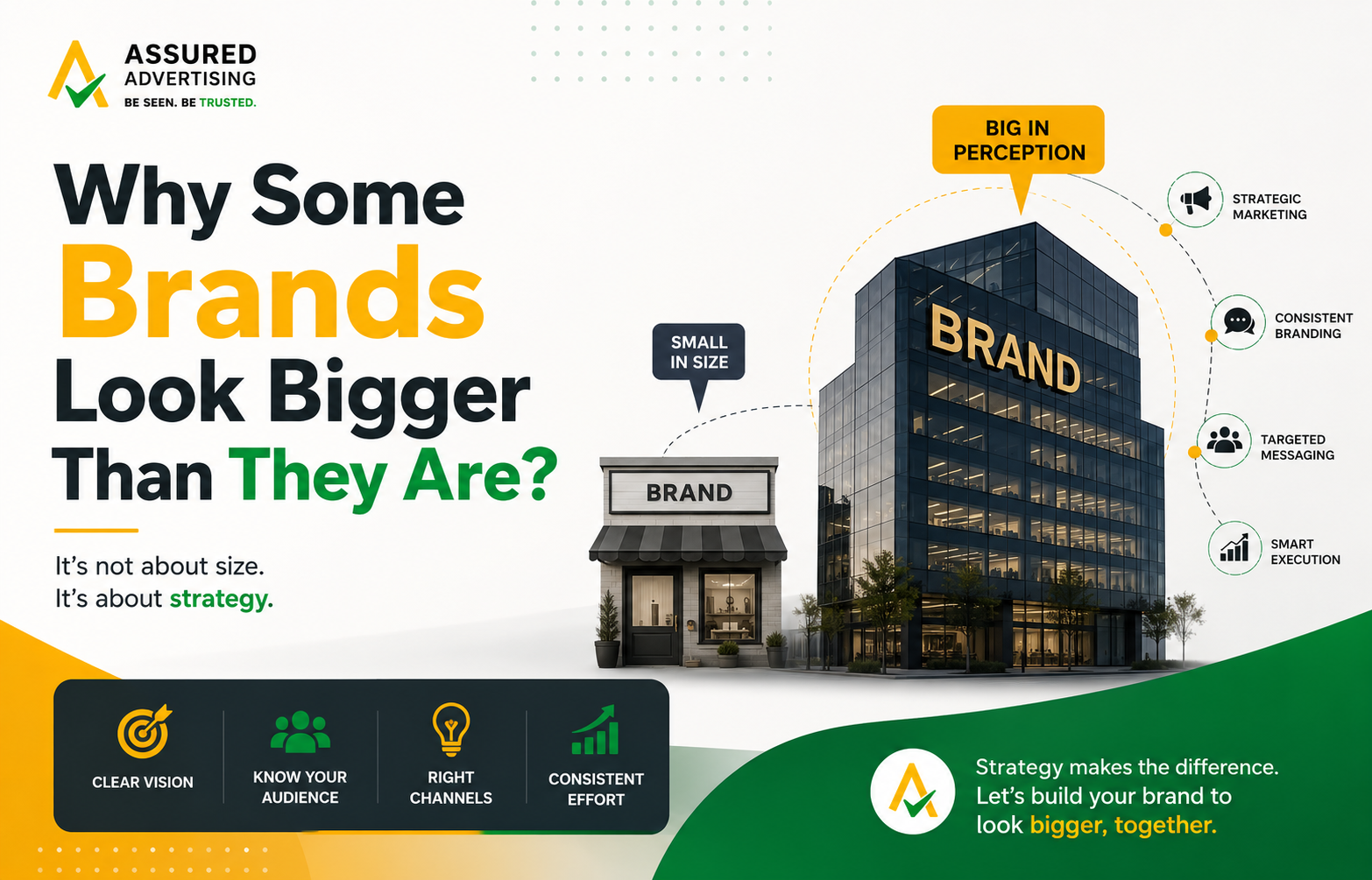
Some brands are not larger than their competitors. They simply appear larger in the market.
That difference is usually built through consistent brand visibility, disciplined media planning and the ability to show up in places that make the brand feel established, trusted, and serious.
For growing businesses, looking bigger often comes down to media placement, public recall and perceived brand scale. People rarely verify how big a company really is. They judge it by what they see, where they see it and how confidently the brand appears in credible public environments.
The goal is not just to be noticed. The goal is to be believed.
Perception Makes Brands Feel Bigger
A brand can have a small team, limited geography or a focused product line and still feel like a major player if its visibility is planned intelligently.
A real estate brand seen across premium catchments, a jewellery brand placed on a high-value road or an education brand appearing in trusted newspaper spaces immediately gains weight in the public mind. The audience may not know the brand’s revenue, size or market share. But they register one thing clearly: this brand seems present.
That is how brand perception works.
The placement changes the meaning of the message. The same ad can feel ordinary in one space and powerful in another. A well-placed ad says the brand belongs. A poorly placed ad simply fills space.
Visibility Without Credibility Is Weak
Many businesses ask how to increase brand visibility, but the better question is: what kind of visibility will improve market trust?
Visibility alone is not enough. A brand can appear frequently and still feel forgettable. The issue is not always lack of advertising. Often, it is lack of strategic media judgment.
Strong brand awareness strategies are not built around random exposure. They are built around the right audience, geography, format and media environment.
For a regional retail brand, that may mean catchment-based outdoor placements. For a real estate developer, it may mean high-impact newspaper and OOH presence in specific zones. For healthcare, education, finance or premium consumer brands, it may mean appearing in spaces where credibility matters as much as reach.
This is the kind of planning Assured Advertising focuses on: helping brands choose media environments that create credibility, not just exposure.
Outdoor Media Creates Public Proof
One reason outdoor advertising remains relevant is that it makes a brand visible in the real world. Unlike digital ads that appear privately on individual screens, outdoor media exists in shared public spaces: roads, business hubs, residential zones and high-movement areas.
When people repeatedly see a brand in physical environments, it starts feeling familiar, active, and established. It becomes part of the city’s visual memory. This is why ooh advertising works well for brands that want local dominance, regional recall or stronger public presence.
Billboard advertising adds another layer. A billboard is not just a large ad. In the right location, it becomes a scale signal. It tells people the brand is confident enough to occupy visible public space.
But not every billboard creates brand value. A weak location, wrong audience, poor visibility or unclear message can waste money quickly. The strength of billboard advertising comes from disciplined planning: location, timing, creative, frequency and audience movement.
A cheap placement is expensive if it reaches the wrong audience.
Why Media Planning Shapes Perception?
Media should never be treated as empty space to be filled. It is a strategic environment where perception is shaped.
That is why choosing the right advertising agency matters. The role of an agency is not simply to buy space in newspapers, magazines, billboards, radio, television or outdoor media. The role is to understand what the brand needs to become in the mind of the market.
Does the brand need more recall? More trust? More local dominance? More premium presence? More seriousness in front of decision-makers?
The answer decides the media plan.
Some brands need print because they need credibility. Some need outdoor because they need public proof. Some need radio because they need frequency and familiarity. Some need television because they need scale and legitimacy. Many need an integrated campaign because one channel alone cannot carry the full perception job.
When a brand feels bigger, people are more likely to consider it safer, more reliable and more worth enquiring about. The biggest-looking brands are not always the biggest spenders. They are often the clearest planners.
Conclusion
Some brands look bigger than they are because they understand the connection between visibility, credibility and perception.
They do not simply advertise more. They appear in the right places. They choose media environments that make them feel serious. They show up consistently enough for the market to remember them and credibly enough for the market to trust them.
For Assured Advertising, the goal is never empty visibility. It is credible visibility that helps brands look present, trusted and serious in the markets that matter.
FAQs
1. Why do some smaller brands look bigger than they are?
Some smaller brands look bigger because they use credible media placements, consistent visibility and strong market signalling. When a brand appears in trusted public environments, people often perceive it as more established and serious.
2. How does outdoor advertising improve brand visibility?
Outdoor advertising improves brand visibility by placing the brand in high-movement public spaces. Repeated exposure in the real world helps build familiarity, recall, local presence and stronger public credibility.
3. Is billboard advertising useful for brand awareness?
Yes, but only when the location, audience, timing and message are planned strategically. Not every billboard creates brand value. A strong billboard placement can create perceived scale and make a brand feel more dominant in a specific market.
4. How can an advertising agency improve brand perception?
An advertising agency improves brand perception by choosing media channels that support the brand’s market goal. The right agency does not just buy space. It plans visibility that builds trust, recall and authority.